Our Agent's Imagination Went From Coin-Flip to Right Six Times Out of Seven
Before our ARC-AGI-3 agent commits a single move, it dreams. A small learned world model — trained around the clock on the agent's own play — imagines the outcome of every available action, and the planner reasons against those imagined futures. Which means the quality of that imagination is not a detail. It is the ceiling on how well the agent can think ahead on games it has never seen — the entire premise of the benchmark.
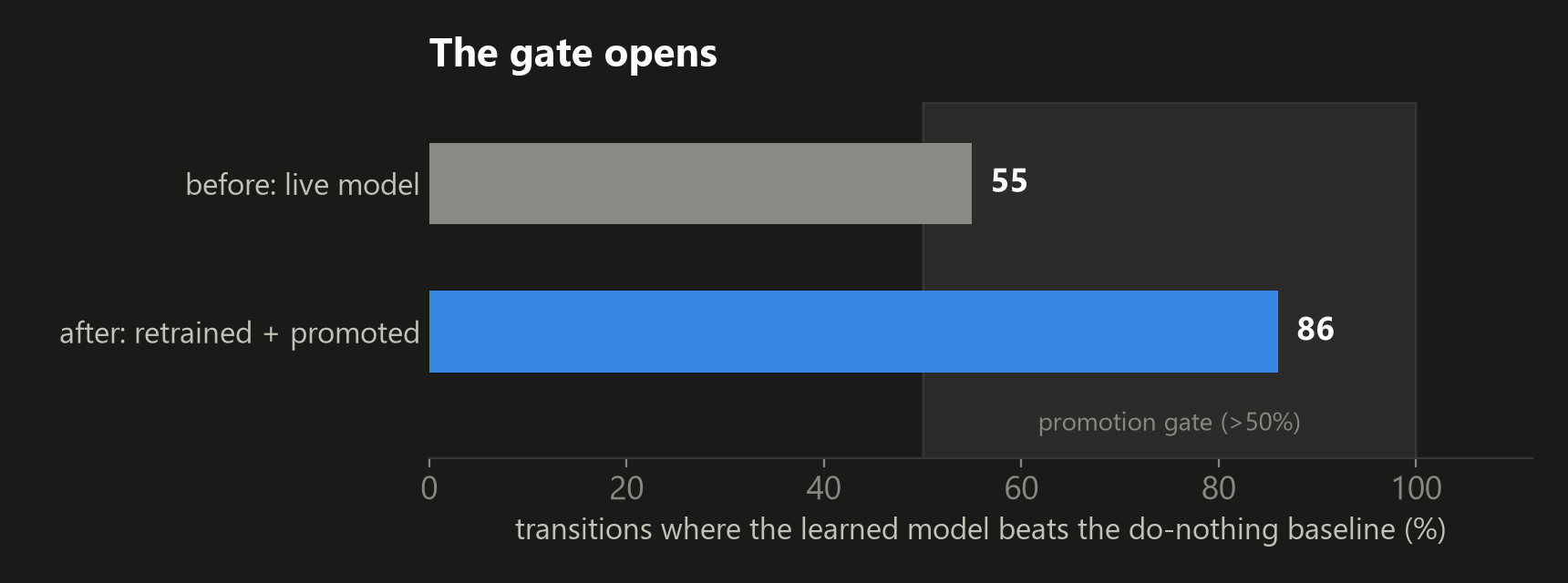
Yesterday, that imagination predicted the board better than "nothing will change" on 55% of transitions. A coin flip. Today it's 86%, and when asked which action produced an observed change, it ranks the true one 1.64 out of 7 — near the top, against a chance rank of 4. Same architecture. Same data sources. One afternoon of work.
Six times out of seven, the dream is right. This is the story of the machine that made that jump routine.
An online learner has to prove it's improving, not just aging
A model that trains 24/7 on its own experience has a notorious failure mode: step counters climb, checkpoints grow, loss ticks down — and none of it tells you whether predictions got better. Online learners don't automatically improve. Sometimes they just get older.
So we gave ours a bar to clear. For every observed transition: does the model's predicted next state land closer to reality than assuming the board doesn't change at all? That beat-identity win rate — plus correctly ranking which action caused what — became a hard promotion gate. No checkpoint touches production without clearing it. Every gate run writes its scores to JSON, so every number in this post regenerates from the artifact that produced it.
That one bar converts a faith-based component into a falsifiable one. And the moment you can falsify, you can experiment.
One variable, four retrains, one decisive answer
We froze a snapshot of the live model — weights plus its full replay buffer of real gameplay — and retrained it four ways on our labelled transition corpus, varying exactly one ingredient: the weight of an inverse-dynamics auxiliary loss, the fashionable add-on in this family of world models. Everything else held constant. Each retrain: about eleven minutes on a CPU.
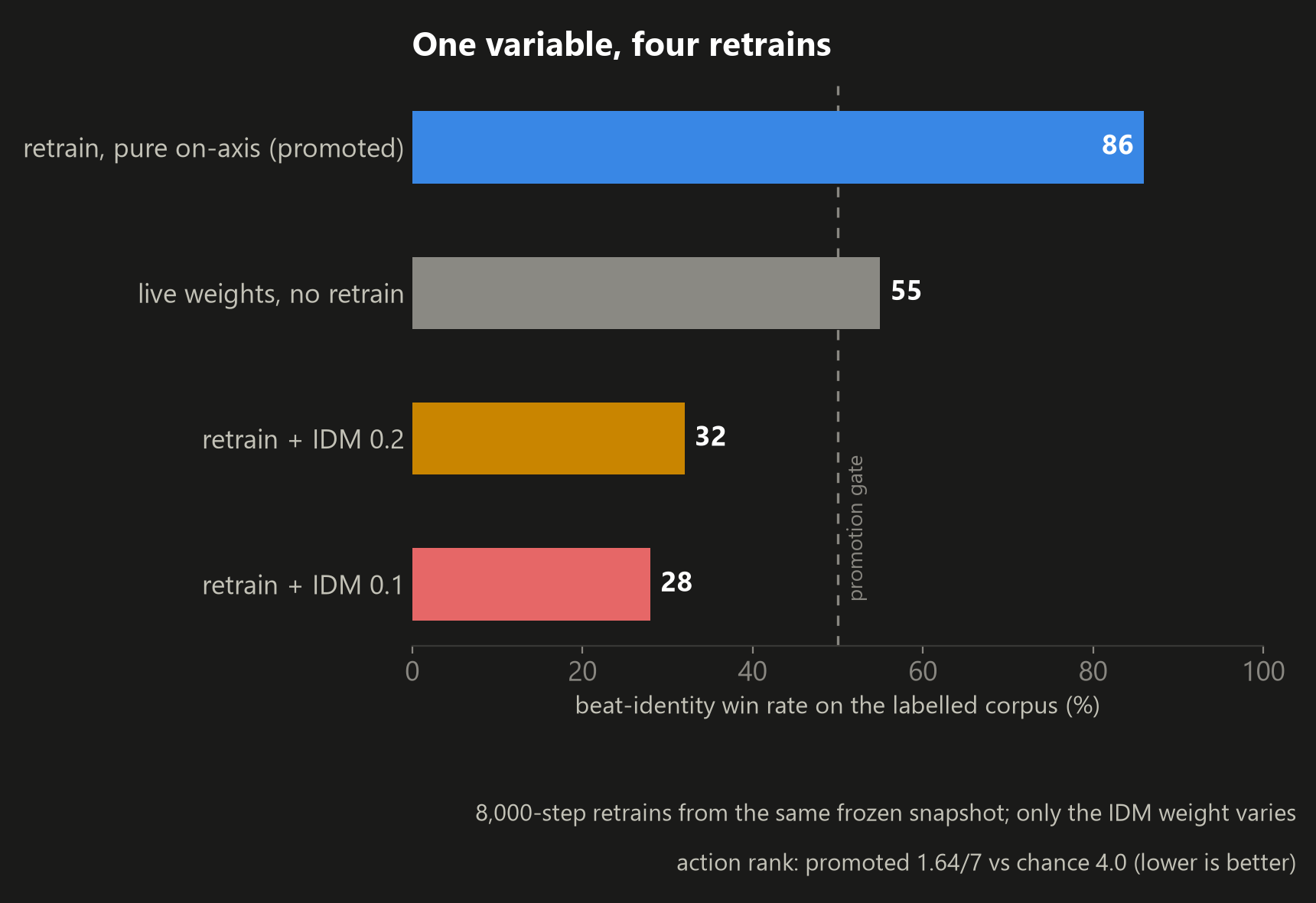
The answer came back as a textbook dose-response curve — and it's a finding, not a config note. Pure, undiluted forward prediction posted an 86% win rate — the best this model family has ever recorded. The fashionable auxiliary loss cut that win rate in half or worse at any dose we tried. In the small-model, online-learning regime, every gradient you spend pulling the predictor toward a side objective is a gradient stolen from the only question the planner ever asks: what happens next? Auxiliary signals belong in detached heads that can't touch the predictor — an experiment we've already scoped.
That's a contrarian, reproducible result about a widely-used technique, produced in an afternoon, by a harness any team could copy: freeze, vary one thing, gate, compare.
Promoted the same day — without losing a single memory
A model that wins offline only matters if it's the one answering the planner. So we shipped it the same afternoon, with one refinement that matters for a system that never stops learning: we grafted the live service's complete replay buffer — 6,675 real transitions across 27 games — onto the winning weights. The production model kept every memory it had accumulated and gained the retrained brain. The service resumed mid-stride; the prior state stays banked as an instant, gate-auditable rollback.
Why this compounds
Foresight quality multiplies through everything downstream. A planner whose imagination is right six times out of seven wastes fewer probes, discovers mechanics faster, and spends its expensive reasoning on choices instead of guesses. You can watch it happen — the promoted model is serving live foresight to the agent playing right now at arc.aitherium.com.
But the durable win is the loop: gate → measure → experiment → promote → rollback banked. That's CI/CD for a learning brain. The cycle that took us from coin-flip to six-of-seven ran start-to-finish in one working day, and it now stands watch over every future checkpoint — which means the next improvement to our agent's imagination is an eleven-minute experiment away.